As a manufacturer of noise barriers, we are always one step ahead in terms of quality, flexibility, and price.
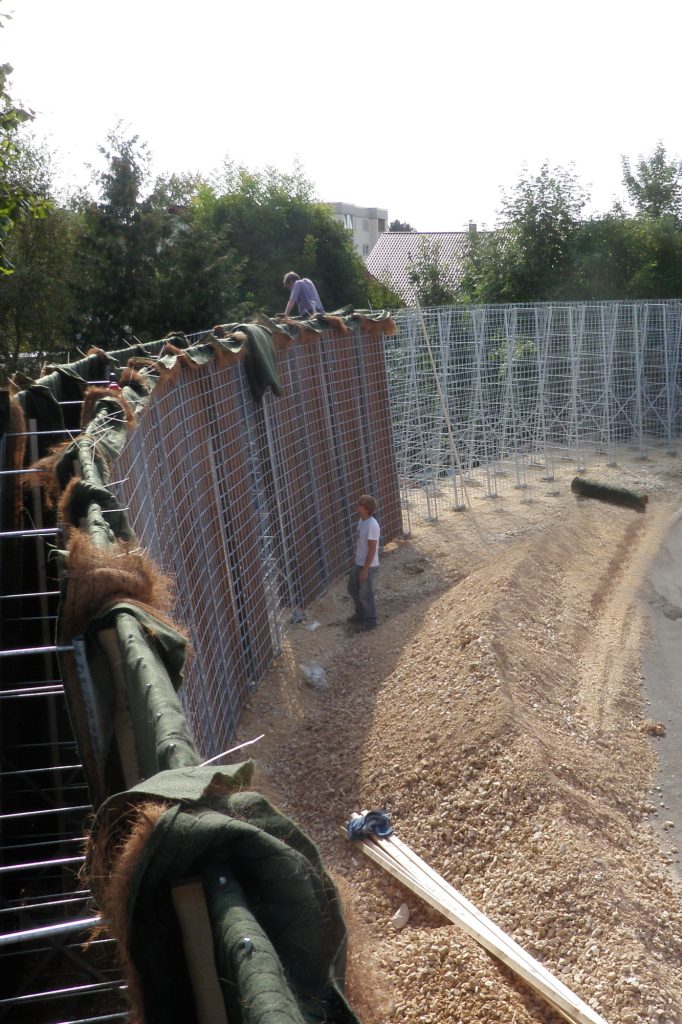
The essence of every sound-insulating noise barrier from Climatewall is a metal lattice construction, with solid and piece-galvanized lattice mats and support profiles, ensuring extreme corrosion resistance and durability. This metal grid construction is lined with our geotextile, Climatewall UV-protect. Comprising rot-proof fiber fleece stitched with coconut fiber, it is UV-resistant and specially manufactured for Climatewall noise barriers, with a service life of 60 years.
The construction is then backfilled with earth substrate. Here, sustainable action and collaboration with local partners are paramount. We source necessary soil or bulk materials from local suppliers of mineral raw materials, ensuring short transport routes. In some cases, excavated material from local road construction is repurposed.
Noise barriers
It’s so green: the right planting
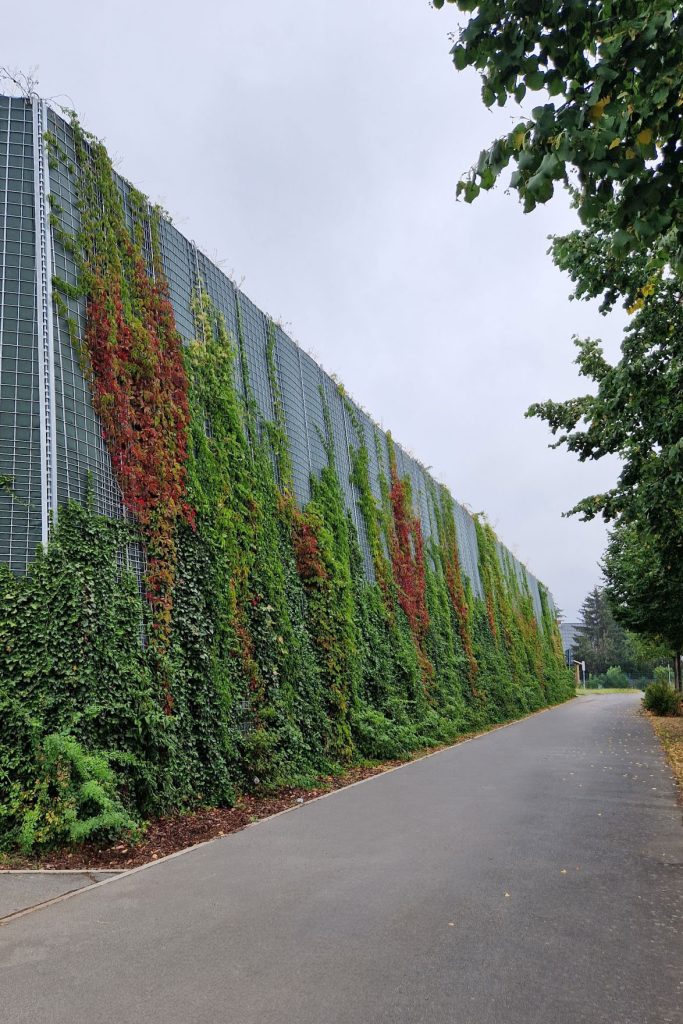
Drawing on our extensive experience in gardening and landscaping, we offer the best advice on selecting plants for our noise barriers. Our goal is to use plants as a deliberate design element, always opting for species native to the respective region. Selection depends on the noise barrier’s location, considering light conditions, soil quality, and the client’s personal preferences.
Tested, Certified, and Proven: Climatewall noise barriers meet all static requirements, holding a European patent, being CE-certified, and complying with DIN EN 1793-2 and DIN EN 20354.
Highest sound insulation
To classify a noise barrier in group B3 with the highest sound insulation per DIN EN 1793-2, a single number value of at least DLR>24dB is required. RAU noise barriers exceed this requirement with a calculated single-number value for airborne sound insulation of DLR=68 dB.
This calculation is based on a minimum area-related mass of the wall of approximately 560 kg/m2 for Climatewall-Product. This results from a volume density of 1.400 kg/m3 when the earth substrate is dry and a minimum density of the Climatewall noise barriers of 40 m. Climatewall Rock has a different structure but meets the required values for classification in group B3 with the highest sound absorption.
Highest sound absorption
For the classification of a noise barrier in group B3 with the highest sound insulation according to DIN EN 1793-2, the ZTV-Lsw 06 (Additional Technical Contract Conditions and Guidelines for the Execution of Noise Barriers on Roads) require a single number value of at least DLR>24dB for the sound insulation.
facts
Sound insulation
Table of calculated frequency-dependent sound insulation values Ri for a noise barrier of the Climatewall noise barrier system with a weight per unit area of 560 kg/m2.
f [Hz]
Ri
100
49,7
125
51,6
160
53,8
200
55,7
250
57,6
315
59,6
400
61,7
500
63,7
630
65,7
800
67,7
1000
69,7
1250
71,6
1600
73,8
2000
74,7
2500
75,6
3150
76,3
4000
77,1
5000
77,8
Sound absorption
Table of sound absorption coefficients αSi determined according to DIN EN 20354 for a noise barrier wall of the Climatewall noise barrier wall system according to test report 97097 /1/.